
A Therapist’s breakdown to session billing
Financing, numbers or anything remotely related to it, gives me the ick, or must I add (gives me the fear LOL 😬). But when it comes to adulting / being a future therapist or a future anything , financing is very important ! So let’s hold each other’s hands and learn some fun math and financing! Trust me on this one…it won’t be boring or scary.
Below are some tidbits you can keep at the top of your mind while sorting through your finances, whether you work at an organization or are self-employed.
Asking for Session Payment as a Therapist
The Money Guilt
💸 Before we start, I want to put this out there: taking money in this profession can feel guilty…and that’s valid. But it is important to charge for your work. You’re not just charging for your time and effort, but also for the countless years spent learning, specialising, breaking down, and still pursuing certifications. So yes, it is absolutely your right to charge for your services.
Advance Payment
💸 This is something I learned during my internship. As a therapist or psychiatrist, remember how much goes into a session…preparation, emotional energy, care, and time. When so much goes into each 50–60 minute session, asking for advance or partial payment is not wrong. It’s very much necessary, especially when you’re just starting out.

Mental Health Insurance Coverage
💸 This one’s for psychiatrists and clinical psychologists who can legally diagnose and treat clinical populations. IRDAI (Insurance Regulatory and Development Authority of India) provides Mental Health Insurance that covers conditions like schizophrenia and mood disorders. So when you see a clinical client, check if they have insurance… or use it as a chance to psychoeducate them about it.
Sliding Scale Fee
💸 Imagine this situation: a prospective client comes to you for therapy, but they either can’t afford your fees, are a student, or don’t have a healthy relationship with money. These situations can be difficult and a little awkward (no sugarcoating there). So what’s the best way to deal with this? Solution: offer a sliding fee range (e.g., ₹200–₹800) or provide discounted sessions for some clients.
Here is a smooth continuation in the same tone—light, warm, slightly humorous, therapist-friendly, and no more than 4 lines per paragraph:
So, What Should be Your Session Price
Your Fee Should Support You
💸 Now let’s talk about setting your actual session price, the part most of us secretly dread. Pricing isn’t about being “expensive”. It’s about being sustainable. Your fee needs to support you, your emotional labour, your training, your boundaries, and the quality of care you want to offer. Think of it less as math and more as self-respect with a calculator.
Number of Session in a Day
💸 When deciding your fee, start by understanding your costs both emotional and financial. How many sessions can you comfortably hold? How much time goes into notes, prep, and recovery? What does it cost to run your life and your practice? Your pricing should create space for you to show up as the therapist you want to be, not one running on fumes.
Clients You are Targeting
💸 Next, consider your professional identity and the community you serve. Your experience, niche, certifications, and the population you work with all shape your pricing. And yes, the city you practice in matters too (therapy in Mumbai ≠ therapy in Mysuru). This isn’t about comparison, it’s about affordability.
When To Change Pricing
💸 And finally, remember that pricing is not permanent; it’s a living, evolving decision. As you grow, your fees will too. Review your rates yearly, check in with your energy levels, and adjust as your practice expands.
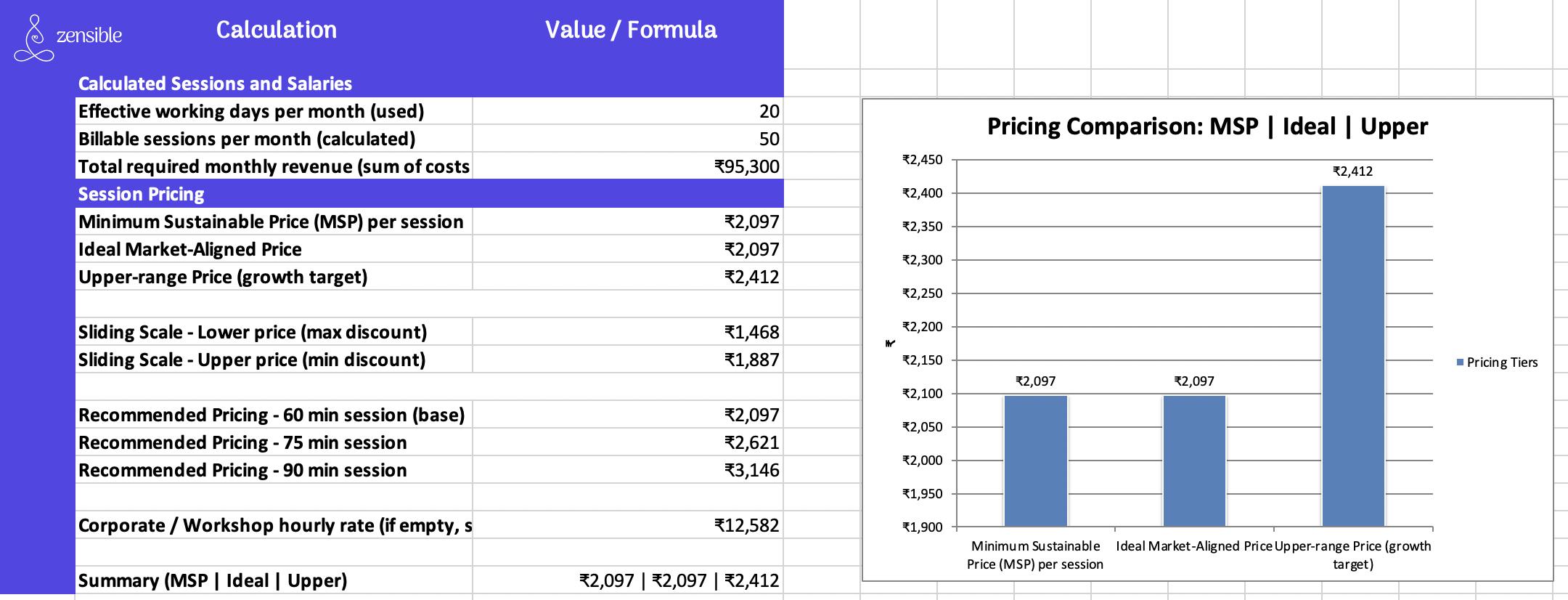
If you need an excel calculator that will automatically calculate all of this, get in touch with us and we will send a quick and easy calculator (see image) that will take away the math and help you calculate this.
